

The press-freedom crisis around 60 Minutes escalated again.
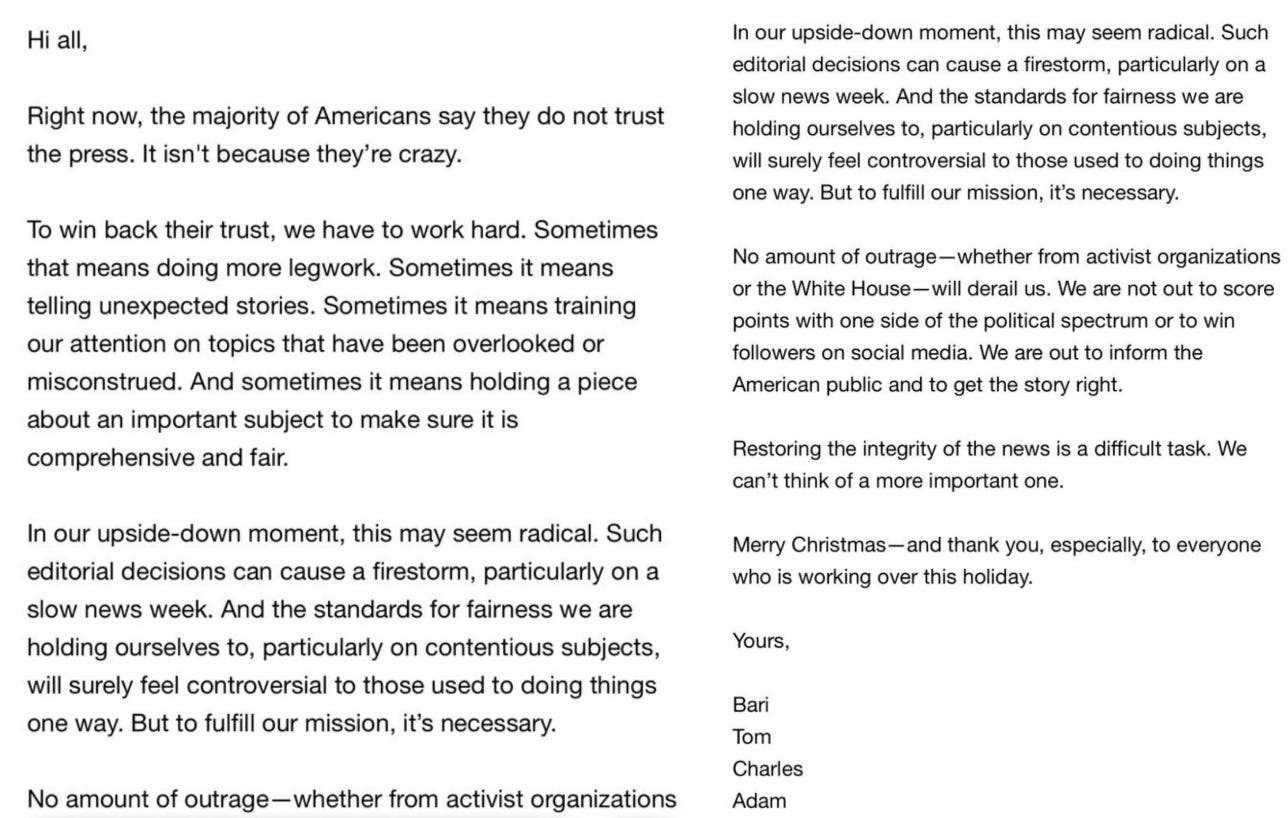
Bari Weiss, the CBS News editor in chief, just sent a Christmas memo to staff doubling down on her decision to spike a completed 60 Minutes investigation into the Trump administration’s deportation of immigrants to El Salvador’s notorious CECOT prison. Hours before, the White House made its expectations unmistakably clear: Deputy Chief of Staff Stephen Miller went on Fox News and called for 60 Minutes producers to be fired.
This is no longer about one segment. It’s about who media power serves — and how quickly intimidation becomes policy.
Before we go further, here’s where readers come in.
Our push is working.
We are sending a strong, visible message that burying accountability comes with consequences, but we can’t do this alone — we need you.
Really American is currently ranked the 3rd fastest-growing Substack in the world.
That growth is not accidental — it’s readers choosing independent journalism over corporate capitulation.
Join us now and help keep the pressure on. Subscribe now.
Now, here’s what Weiss said — and what it means.
In her memo, Weiss framed the decision to pull the 60 Minutes segment as an act of integrity. She argued that the press must “win back the public’s trust,” and that sometimes doing so requires holding a piece to ensure it is “comprehensive and fair.” She insisted CBS News is not trying to appease any political faction or chase social media attention.
But that explanation collapses under scrutiny.
The segment had already cleared legal review, standards, and internal vetting. Reporter Sharyn Alfonsi told colleagues the decision was political, not editorial — a claim widely reported across the media industry.
And the timing matters.
CBS News is owned by Paramount Global, which recently acquired Weiss’s own outlet, The Free Press, in a deal reportedly worth around $150 million. Paramount is now navigating high-stakes mergers and regulatory reviews — processes the Trump administration has openly said it intends to influence.
This is how media stops functioning as a watchdog and starts behaving like a conglomerate aligned with power.
When ownership structures, regulatory pressure, and political retaliation collide, editorial “caution” becomes indistinguishable from compliance. The result is a media ecosystem that quietly adjusts itself around Donald Trump — not because of a formal order, but because the incentives all point in the same direction.
Then came Stephen Miller’s demand.
On Fox News, Miller accused 60 Minutes producers of staging a “revolt” against Weiss and urged CBS to “clean house” by firing them. He dismissed the reporting as a “hatchet job,” labeled deported men “monsters,” and mocked journalists for living “in comfort and security” while daring to report on abuses.
The message was chillingly clear: challenge the administration, and your job is on the line.
Taken together, the pattern is impossible to ignore.
A major network kills a sensitive investigation.
Corporate leadership publicly defends the decision.
The White House calls for journalists to be fired.
This is not coincidence. It is consolidation — of power, of narrative control, and of media institutions increasingly orbiting the Trump presidency.
Weiss’s memo insists that “no amount of outrage — whether from activist organizations or the White House — will derail us.” But the reporting is already gone. The pressure already worked.
That’s the danger.
When intimidation no longer needs to be explicit — when stories disappear preemptively and journalists are warned off by example — censorship doesn’t arrive with a ban. It arrives with a memo.
This is why independent journalism matters right now.
Corporate media conglomerates are constrained by mergers, regulators, and political leverage. Independent outlets answer to readers — not presidents, not conglomerates, not aspiring oligarchs.
And readers are responding.
Really American is one of the fastest-growing publications on Substack because people see what’s happening — and they’re choosing journalism that refuses to blink.
If you believe journalists should not be fired for doing their jobs, join us.
If you believe media should not function as a subsidiary of any president, support independent reporting.
Become a paid subscriber today and help us keep this pressure where it belongs — on power.
More soon,
The Really American Team


